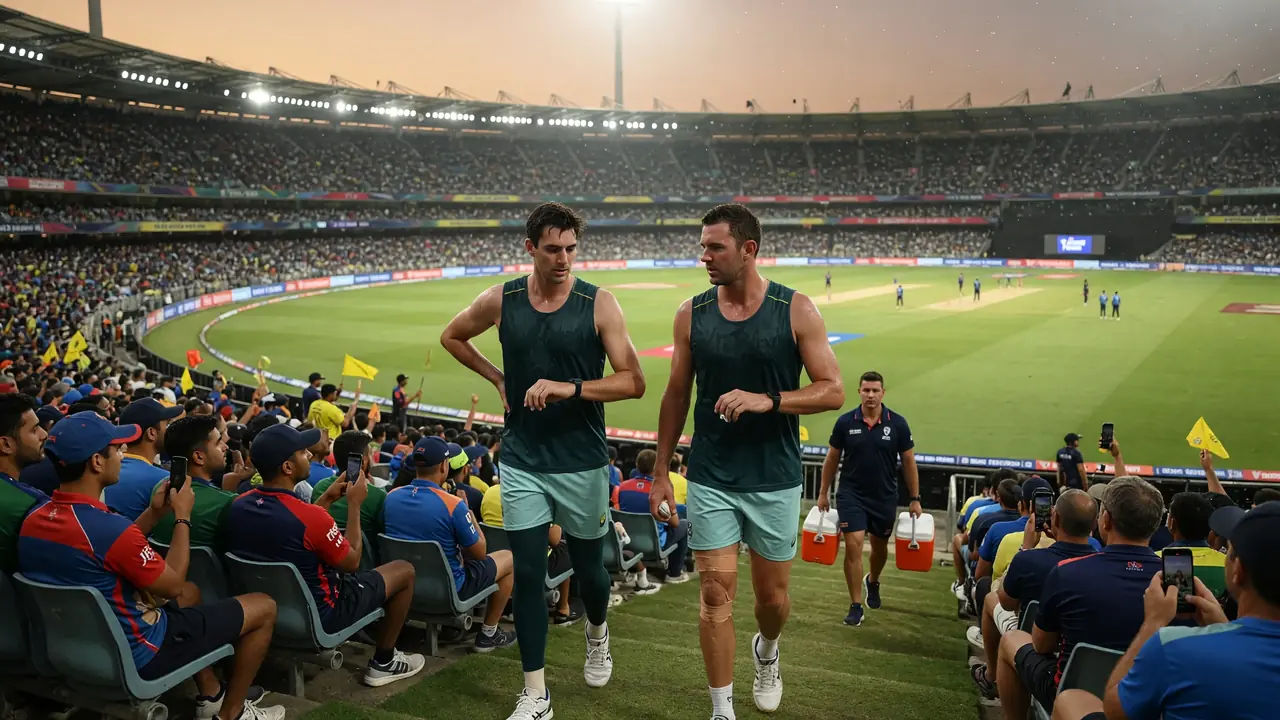
On 18 February 2026, ESPNcricinfo published Alex Malcolm’s report on Australia’s early T20 World Cup exit and the fitness outlook for the two pacers who never made the XI. Selector Tony Dodemaide told reporters that Pat Cummins and Josh Hazlewood remained very likely to be available for the Indian Premier League, barring fresh setbacks. He framed the missed World Cup not as a closed medical chapter, but as a scheduling collision: the same recovery windows that kept both men out of the tournament still pointed toward franchise readiness a few weeks later.
For Indian fantasy and franchise readers who track overseas pace stocks through the Exchange22 players database, the February briefing was a clean player-availability note. Cummins and Hazlewood had played only one game between them in three months. Both had been described as huge losses on the eve of the World Cup. Yet Dodemaide’s public line was calm rather than open-ended: the IPL window still sat inside the recovery plan, provided nothing else went wrong.
What the 18 February 2026 briefing established
The core claim was narrow and useful. Despite the pair’s absence from Australia’s World Cup campaign, both were considered very likely to be fit for the IPL unless further setbacks intervened. Dodemaide went further on the calendar logic. He said it was a timing issue, and that if the IPL had come first they would have missed the IPL to play the World Cup. In other words, national-event priority had already been exercised; the remaining question was whether the same bodies would clear franchise workload on the next stop of the white-ball year.
That distinction mattered because the public had just watched Australia leave the group stage without either spearhead. Losses to Zimbabwe and Sri Lanka ended the campaign. Across those two defeats Australia took only four wickets, all of them by allrounders Marcus Stoinis and Cameron Green. The bowling ledger was thin enough that any later comment about Cummins and Hazlewood was bound to be read as a post-mortem on selection as much as a medical update. Dodemaide’s answer refused that trap. He treated the injuries as real, the absences as costly, and the IPL outlook as still favourable on the existing timeline.
Malcolm’s report also fixed the human details that fantasy boards need. Hazlewood was still struggling with Achilles and calf issues after initially suffering a hamstring injury on 12 November. Cummins had not played since one appearance in the third Ashes Test in mid-December, where he took six wickets in 34 overs across two innings as Australia sealed the series 3-0. He had then been shut down to protect a lumbar stress issue with the T20 World Cup in mind, only to be withdrawn from the initial squad. Those are not interchangeable soft-tissue notes. They are two different load-management stories that happened to converge on the same tournament.
Hazlewood’s long path from November hamstring to February uncertainty
Hazlewood’s file began earlier than the World Cup itself. The hamstring injury on 12 November was the first hard stop. By mid-February he was still dealing with Achilles and calf problems layered on top of that original setback. That sequence explains why his absence felt less like a late scare and more like a recovery that never quite lined up with the tournament start. Fast bowlers can bowl through managed niggles. They rarely clear stacked lower-limb issues on a fixed ICC date without residual risk.
The February language around Hazlewood was therefore cautious even while the IPL outlook stayed positive. “Still struggling” is not the same as “ruled out for months.” It describes a bowler who had not yet produced a clean, match-ready block of bowling under tournament pressure. For franchise medical staff, that is a monitoring case rather than a closed rejection. For Australia’s World Cup group, it was already too late. The tournament does not wait for calf and Achilles confidence to return in the same week a squad needs new-ball control against Sri Lanka or Zimbabwe.
Hazlewood’s absence also shaped the cover decision around Steven Smith. Smith was flown in late as cover and officially included as Hazlewood’s replacement. Selectors still viewed him primarily as a back-up opener, and he was not picked for the Sri Lanka game. That detail is easy to miss if the story is read only as a bowling injury note. The official replacement slot was filled by a batter whose intended role remained secondary opening cover. Australia did not answer Hazlewood’s overs with another specialist quick in that late move. They answered a squad vacancy with a multi-purpose senior batter and then still left him out of a decisive fixture.
Cummins: one Ashes night, then a lumbar shutdown
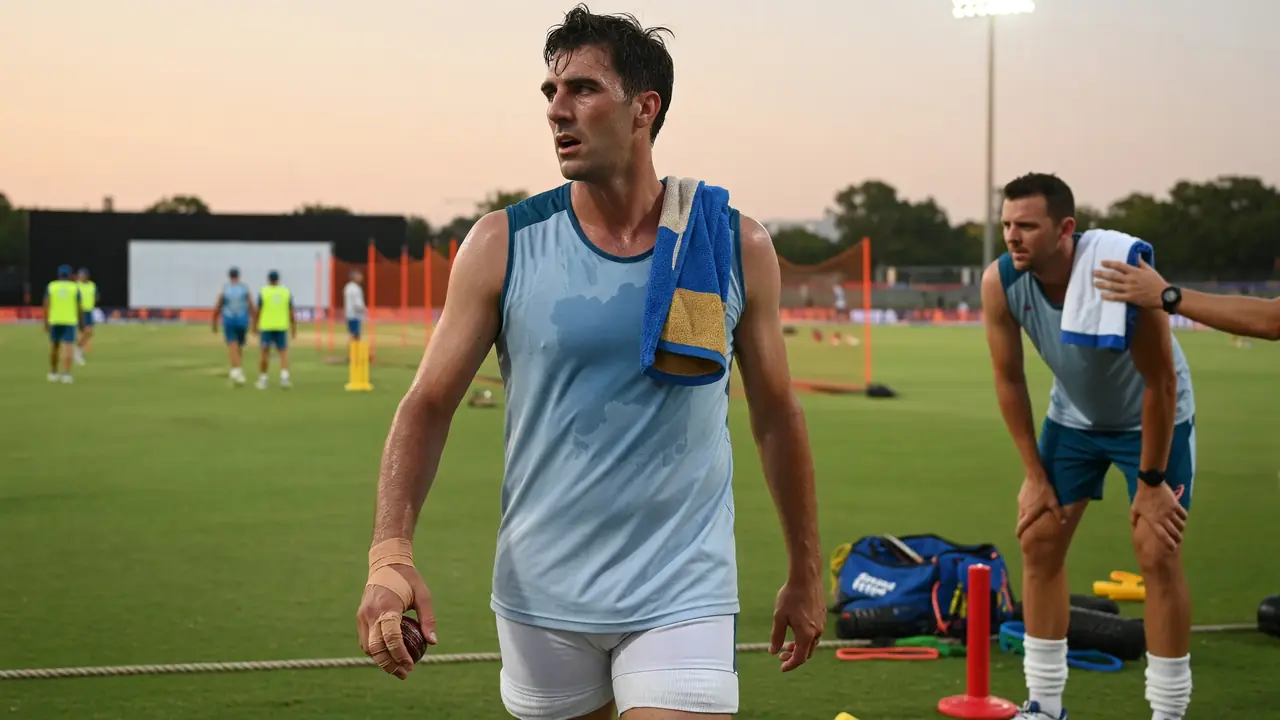
Cummins’ arc was sharper. His only outing in the three-month window cited in the report was the third Ashes Test in mid-December. In that single appearance he took six wickets in 34 overs across two innings, and Australia closed the series 3-0. The bowling return was classic Cummins: heavy overs, decisive impact, series sealed. The medical decision that followed was protective rather than reactive to a collapse in that match. He was shut down to protect a lumbar stress issue with the T20 World Cup as the target event, then withdrawn from the initial squad anyway.
That order of events is important for anyone still reconstructing the winter. The shutdown was intended to preserve him for the World Cup. The withdrawal meant the preservation plan did not reach the required clearance in time. By 18 February, Dodemaide was no longer talking about rushing Cummins into a global event that Australia had already exited. He was talking about the next dense block on the calendar: the IPL, where franchise minutes are long, travel is constant, and a captain-leader quick is asked to own powerplay and death overs across two months.
The lumbar label also separates Cummins from Hazlewood in practical terms. Lower-back stress management is about bowling loads, recovery days and how quickly a body tolerates repeated spells. Achilles and calf management is about push-off confidence, sprint mechanics and whether the lower limb accepts repeated decelerations. Both can keep a bowler out of a short tournament. Both can still clear a slightly later franchise start if the underlying trend is positive and no fresh scan forces another stop. Dodemaide’s “timing issue” line sat on that shared possibility without pretending the injuries were identical.
How Australia’s group-stage bowling made the absences visible
Context from the on-field ledger sharpened every fitness question. Australia’s losses to Zimbabwe and Sri Lanka produced only four wickets in total, all by Stoinis and Green. When allrounders are the entire wicket column, the missing specialist quicks stop being abstract selection debates. They become the simplest explanation for a group-stage exit that left the attack short of penetration.
The report’s eve-of-tournament language had already called Cummins and Hazlewood huge losses. The group-stage numbers made that description concrete. A side built around elite pace depth suddenly had to manufacture wickets through part-time or dual-role overs. That is a different tactical sport. Field settings change. Middle-over plans stretch. Death overs lose the bowler who usually owns the hard lengths. None of that required Dodemaide to reopen the medical files in public. The scorecards had already shown what the absences cost.
Even so, the February briefing refused to convert a failed campaign into a long-term write-off of either player. That restraint is the editorial heart of the piece. Australia had been knocked out. The attack had under-delivered without its two main quicks. The selector’s job in that moment was not to feed a blame cycle. It was to state whether the same two bodies still had a usable runway toward franchise cricket. His answer was yes, with the usual injury caveat.
Why Dodemaide called it a timing issue
The most reusable sentence from the briefing was Dodemaide’s timing formulation. If the IPL had come first, he said, Cummins and Hazlewood would have missed the IPL to play the World Cup. That is a priority statement dressed as a calendar note. It tells franchise readers that Australia had already chosen the global event when the recovery curves were incomplete. It also tells them the incomplete curves were not being read as season-ending.
Timing language is often used to blur bad news. Here it did the opposite. It acknowledged that the World Cup date had been missed for medical reasons, while keeping the next date open. “Very likely” still carried a condition — barring further setbacks — but it was not the language of indefinite rehabilitation. For IPL teams holding Cummins or Hazlewood contracts, that was the difference between planning around a delayed arrival and planning around a vacant overseas slot.
The line also protects against a false binary that often creeps into injury coverage: either a player is fully fit for every event or the career block is broken. Elite quicks live in the middle ground for long stretches of a year. They miss one window, make the next, and manage loads between series. Dodemaide’s public comment placed both men in that ordinary high-performance middle rather than in a crisis narrative after Australia’s early exit.
Smith’s late arrival and the limits of cover
Steven Smith’s late flight into the squad is the secondary player story inside the same report. He was officially included as Hazlewood’s replacement, yet selectors continued to view him primarily as a back-up opener. He was not selected for the Sri Lanka match. The combination is revealing. A replacement tag can satisfy a squad-list requirement without changing the tactical XI. Australia gained a senior batter on the bench and still entered a must-win style group fixture without converting that cover into a specialist bowling answer.
For player-database readers, Smith’s status in that window should be stored carefully. He was available as cover, not re-cast as a bowling substitute in any meaningful on-field sense. The replacement paperwork followed Hazlewood’s injury. The selection instinct still treated Smith as batting insurance. Those two facts can sit together without contradiction, and they explain why the bowling ledger against Zimbabwe and Sri Lanka remained so thin even after the late call-up.
The episode is also a reminder that injury replacements at major events are not always like-for-like. A missing new-ball bowler can be replaced on the team sheet by a batter if the management prefers experience, dressing-room balance or top-order contingency over another seam option. Whether that was the optimal World Cup call is outside the verified record. What the record does show is the official designation, the intended role, and the non-selection against Sri Lanka.
The Sheffield Shield date that sat behind the IPL talk
Buried under the franchise headline was a domestic calendar marker. Even IPL-bound players were expected to be available for Sheffield Shield round nine starting on 5 March after the team returned home following the final game against Oman. That sentence does quiet work. It says Australia still wanted first-class overs from the wider group once the World Cup party came home. It also places 5 March as a concrete waypoint between the failed white-ball campaign and the IPL build-up.
For Cummins and Hazlewood specifically, the Shield note is best read as system context rather than a confirmed personal appearance guarantee. The report’s strongest personal claim remained the IPL likelihood. The Shield expectation applied to IPL-bound players as a class after the Oman fixture closed the World Cup schedule. In practical terms, Australian domestic cricket was not emptying itself the moment the global event ended. Round nine was still on the map.
That matters for how the February story ages. Looking back from August 2026, the sequence is orderly: World Cup exit, selector briefing on 18 February, Oman to close the tournament slate, Shield round nine from 5 March, then the IPL runway. Dodemaide’s fitness comments sit in the middle of that chain. They were not vague optimism thrown into a vacuum. They were a medical-calendar judgment offered while the next domestic and franchise dates were already visible.
What the player records actually said in February
Strip the narrative down to the verified player facts and the picture is stark. Between them, Cummins and Hazlewood had one competitive appearance in three months. That appearance belonged to Cummins in the third Ashes Test, with six wickets from 34 overs as the series finished 3-0. Hazlewood’s last hard injury marker in the report was the 12 November hamstring, followed by ongoing Achilles and calf trouble into February. Cummins’ World Cup plan had been a lumbar-protection shutdown that still ended in a squad withdrawal.
Those facts explain both the World Cup damage and the cautious optimism about the IPL. A three-month near-blank is enough to leave any attack short at a global event. It is not automatically enough to erase franchise availability if the underlying issues are trending the right way and the next start date is several weeks out. Dodemaide chose the second reading. He did not claim either man was bowling unrestricted in the nets for television cameras. He claimed the IPL remained a realistic target if no new problem appeared.
Fantasy managers who price overseas captains and premium pacers needed exactly that level of precision. “Out of the World Cup” is not the same row as “out of the IPL.” “Lumbar management after a six-wicket Ashes Test” is not the same row as “season-ending surgery.” “Achilles and calf still unsettled after a November hamstring” is not the same row as “cleared and bowling full tilt.” The February dossier kept those distinctions intact.
How franchise desks should have filed the update
From an IPL operations view, the actionable output of 18 February was simple. Keep Cummins and Hazlewood inside the available-or-monitoring band rather than the long-term absence band. Keep the caveat visible: further setbacks would reopen the question. Do not rewrite either player’s role identity because Australia’s group-stage attack failed without them. The World Cup result explained the cost of their absence. It did not redefine their franchise jobs.
The same filing should have captured Dodemaide’s priority line. Australia had already demonstrated that the World Cup outranked the IPL if only one window could be hit. Once the World Cup was gone, the IPL became the next test of the same recovery plans. That is ordinary international-to-franchise sequencing, not a special exemption. It also means any later debate about divided loyalties in that specific winter is largely answered by the selector’s own words: the global event had first claim; the league was the follow-on target.
Smith’s cover role belongs in a separate line of the same file. Official replacement for Hazlewood. Intended as back-up opener. Unused against Sri Lanka. Those three facts prevent the late call-up from being misread as a bowling reinforcement. They also keep the four-wicket group-stage ledger honest. Australia did not suddenly regain a specialist quick when Smith landed. They gained batting cover that selection then declined to use in at least one key match.
Why the February snapshot still holds as a player marker
Months later, the value of Malcolm’s 18 February report is archival clarity. It freezes a specific claim at a specific hour in the white-ball year: after Australia’s early exit, the national selector still expected Cummins and Hazlewood to make the IPL unless something else broke. It records the injuries without glamour. It records the World Cup damage without turning the bowling card into mythology. And it records the next domestic date, Shield round nine from 5 March, as part of the same homecoming plan after Oman.
That is enough to keep the player entries honest. Cummins’ last match before the briefing was the mid-December Ashes Test with six wickets in 34 overs. Hazlewood’s injury chain ran from a 12 November hamstring into Achilles and calf trouble that still lingered in February. Both missed the World Cup. Both were still framed as probable IPL contributors on timing grounds. Smith’s late arrival filled a replacement slot without changing the specialist bowling picture.
The lasting lesson is narrower than a campaign autopsy. Elite pace stocks can miss a peak event and still sit on a realistic franchise timeline if the medical trend and the calendar allow it. Dodemaide said the quiet part in public: the World Cup date had been the priority, the IPL date remained live, and the difference between those two outcomes was timing. For anyone reconstructing how Australia’s quicks moved from an Ashes finish through a failed T20 World Cup and toward the Indian league that year, the 18 February briefing remains the cleanest single marker in the record.
Frequently asked questions
Why did Pat Cummins and Josh Hazlewood miss the T20 World Cup 2026?
Both missed Australia’s campaign through injury. Hazlewood was still dealing with Achilles and calf problems after a hamstring injury on 12 November, while Cummins had been shut down to protect a lumbar stress issue and was withdrawn from the initial squad.
What did selector Tony Dodemaide say about their IPL fitness?
On 18 February 2026, Dodemaide told reporters the pair’s likely IPL availability was a timing issue. He added that if the IPL had come first, they would have missed the IPL to play the World Cup.
When had Pat Cummins last played before that assessment?
Cummins had not played since one appearance in the third Ashes Test in mid-December, where he took six wickets in 34 overs across two innings as Australia sealed the series 3-0.
How many wickets did Australia take in the losses that ended their group stage?
Australia took only four wickets across losses to Zimbabwe and Sri Lanka, all by allrounders Marcus Stoinis and Cameron Green.
What role did Steven Smith play after being flown in late?
Steven Smith was flown in late as cover and officially included as Hazlewood’s replacement, but selectors still viewed him primarily as a back-up opener and he was not picked for the Sri Lanka game.
Were IPL-bound Australians still expected for Sheffield Shield round nine?
Yes. Even IPL-bound players were expected to be available for Sheffield Shield round nine starting on 5 March after the team returned home following the final game against Oman.